Talking through stories
How to involve your child in storytime without turning it into a test
Questions can open a conversation, but a question on every page can make a child search for the answer an adult wants. This guide replaces “ask–check–correct” with “notice–invite–listen,” so children can participate while stories remain safe and enjoyable.
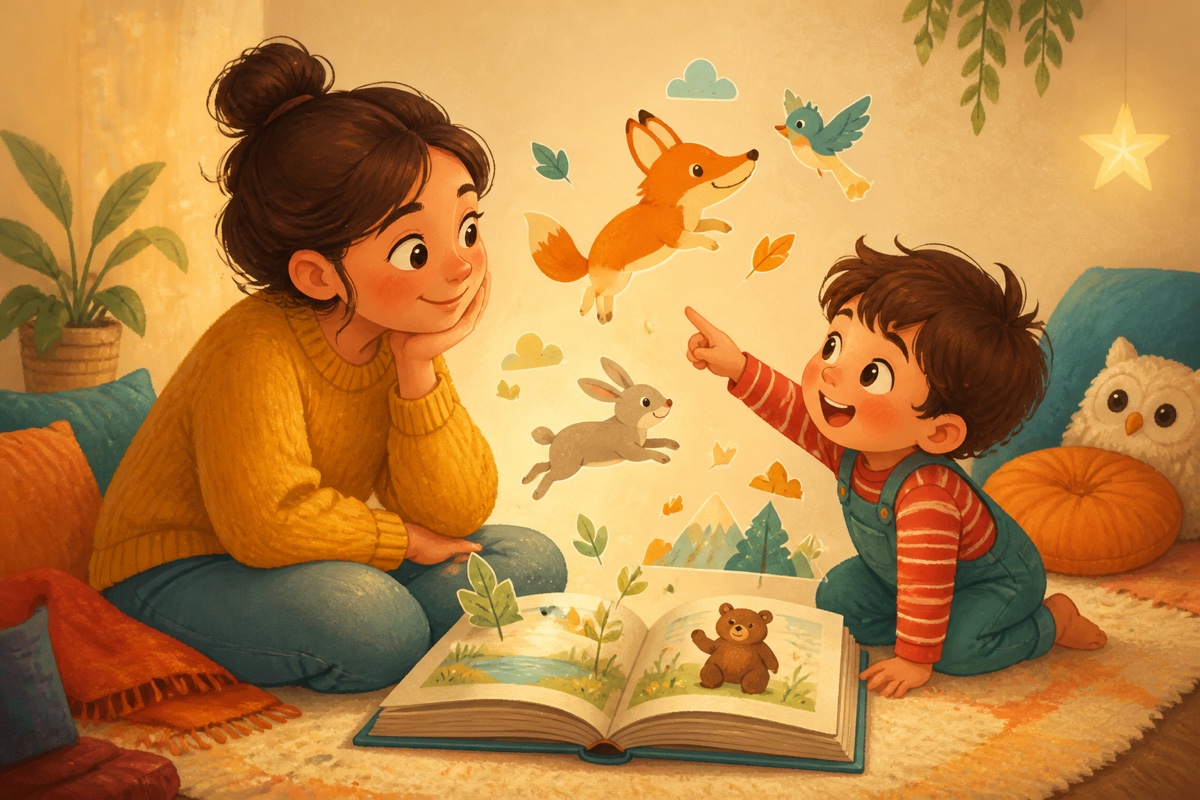
Participation does not always look like answering
A child may participate by studying a picture, laughing, moving, making a sound, turning backward, or mentioning a memory sparked by the image. These are all signs of processing. Recognizing them keeps adults from measuring attention only by the number of spoken answers.
The AAP technical review notes that higher-quality shared reading includes verbal and nonverbal interaction. Dialogic approaches use prompts and responses to let the child become more of the storyteller, but the point is reciprocal conversation—not completing a checklist of questions.
Use comments as bridges before questions
Instead of opening a page with “What color is that?” try “The sky looks very dark here,” and wait. The child may say it is scary, point to a small light, or simply keep looking. A comment models language without demanding an answer.
When the child responds, expand their words. If they say “He's scared,” you might add, “Yes, his arms are wrapped tightly around him.” This adds vocabulary and attention to visual evidence without implying the first answer was inadequate.
Choose questions without one correct answer
Recall questions have a place, but they need not dominate. Ask about feelings, reasons, predictions, or alternatives: “What might the character be thinking?” “What else could work?” or “What in the picture gave you that idea?”
After asking, genuinely wait. Children need time to assemble an idea. If the adult answers immediately, the child learns that the silence was never theirs. Count quietly to five and welcome an unexpected interpretation when the story supports it.
- Before: What does this cover remind you of?
- During: What are some things that could happen next?
- After: If you could change one thing, what would it be?
Know when to stop asking
Warning signs include repeated “I don't know,” watching the adult instead of the book to detect the right answer, hurried page-turning, or asking you to continue. When these appear, return to narrating, making a sound, or reading the text without interruption.
Some evenings a child wants a familiar story with no discussion. Anticipating known words and events has value too. Reading does not have to become more challenging every time; the security of a predictable pattern may be exactly what the child needs that day.
When the child's interpretation differs from yours
Begin with “Tell me a little more” instead of “No.” The child may have noticed a detail you missed or used personal experience to fill a gap. In fiction, several interpretations can sit beside one another.
If the answer concerns safety or an incorrect real-world fact, separate listening from correction. Hear the idea first, then give brief, direct information without ridicule: “We can imagine that in the story, but in real life we don't touch fire because it can burn skin.”
Try the approach with these stories
Continue reading
Sources
- Literacy Promotion: An Essential Component of Primary Care Pediatric Practice: Technical Report — American Academy of Pediatrics (2024)
- How to teach your child to love reading — UNICEF Parenting