Choosing stories
How to choose stories for your child's age, feelings, and interests
An age label is a starting point, not a verdict. The same story may fit one child and overwhelm or bore another. A useful choice considers three things together: what this child is ready for, what this story asks of them, and what time and emotional capacity the family has today.
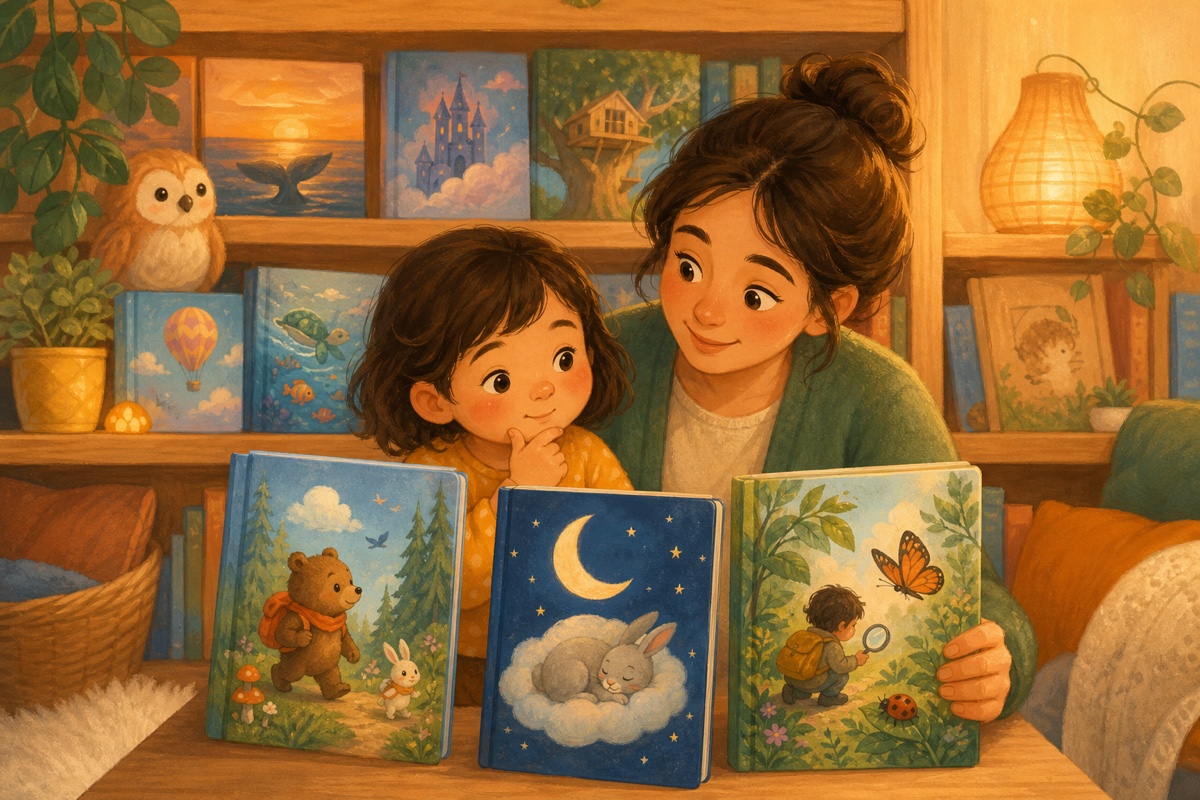
Begin with the child, not with what they 'should' read
Notice how many events your child can follow, how much sentence complexity they enjoy, and what level of suspense feels manageable. Children of the same age differ in language experience, familiarity with stories, and sensitivity to images. Treat age guidance as an initial filter and adjust from the child's actual response.
Thailand's Department of Health suggests large familiar images for ages 0–1, picture books about daily life, animals, and objects for ages 2–3, and longer but still accessible imaginative stories for ages 4–5. Such guidance helps with a first pass, but it is not a reason to stop an older child revisiting a simple favorite or force a younger child up to an age label.
Evaluate a story in five dimensions
First, length: can it pause or split naturally? Second, language: are there enough new words to learn without losing the story? Third, pictures: do they support events and emotions? Fourth, plot: do the number of characters and time shifts fit the child's experience? Fifth, emotion: how intense are fear, loss, conflict, or embarrassment?
A worthwhile story does not need to announce a moral. Humor, fantasy, and open questions have value too. Look for understandable motives, consequences worth discussing, and room for children to think rather than a story that supplies every conclusion.
Match the story to the mood and time of day
An exciting story may work on a weekend afternoon but not before bed for a sensitive child. After a major change, a story reflecting the same feeling could open conversation—or feel too close. Offer both a relevant story and a lighter alternative.
Avoid using characters as tools for criticism: “See, a good child does this.” That can associate books with correction rather than curiosity. If you hope to discuss a feeling, begin with the character and let the child decide whether to connect it to themselves.
When your child wants only one story or subject
Repetition lets children predict, participate, and notice fresh details. A temporary narrow interest does not need to be fixed. Use it as a bridge: from vehicles helping friends, to journeys, then communities or maps.
Try a simple ratio—two familiar choices for every experimental one—and never require the new story to be finished. Put it away and return another day if it is rejected. Expansion works best when something recognizable connects the new subject to the old interest.
Handling frightening scenes and difficult subjects
Give a content note without revealing everything: “The character gets lost for a while, but reaches safety at the end.” Let the child control whether to stop, skip, or view the picture from farther away. Do not force the story to test bravery.
If fear remains afterward, affirm the feeling, separate fiction from the child's real situation, and revisit the safe resolution. Children with experiences of loss, violence, or specific anxiety may need more careful selection than general age guidance can provide. Seek appropriate professional help when fear disrupts daily life.
Examples matched to readiness
Continue reading
Sources
- เลี้ยงลูกนิทาน... ตามวัย — กรมอนามัย กระทรวงสาธารณสุข
- Literacy Promotion: An Essential Component of Primary Care Pediatric Practice — American Academy of Pediatrics (2024)
- How to teach your child to love reading — UNICEF Parenting