Aesop's Fables
The Bear and the Two Travelers
⏱ 3–5 min
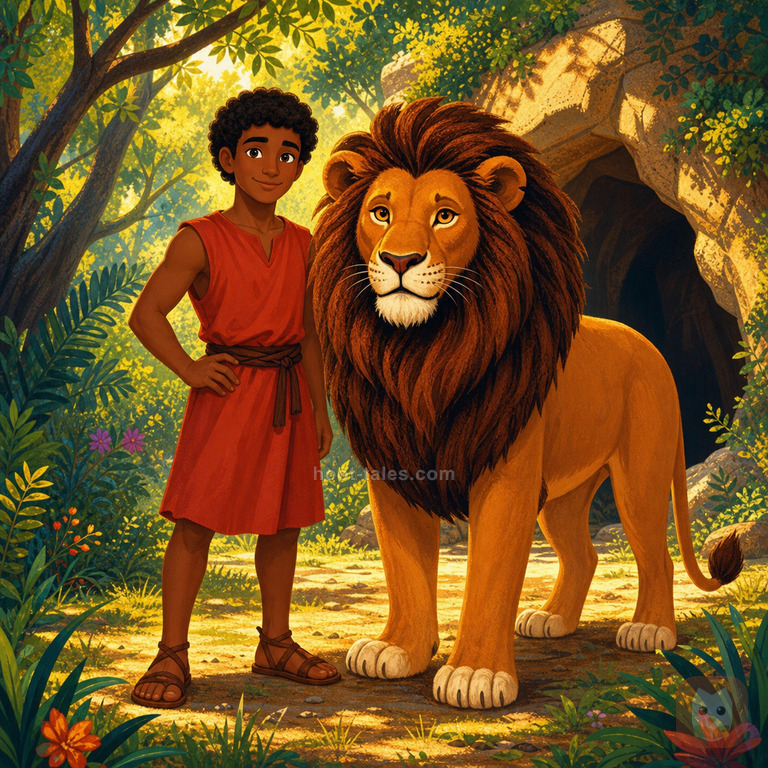
A lion was resting under a great tree in the forest when a little mouse accidentally scurried right across him, startling him awake and making him furious.
The lion pinned the little mouse firmly under his paw. Trembling, the mouse begged, "Please let me go. One day I might be able to help you too." The lion laughed, but kindly let it go.
A few days later, the lion was caught in a hunter's net. No matter how hard he struggled, the ropes held tight, and he roared out in despair.
The little mouse heard the roar and rushed over. Seeing the lion trapped, it quickly gnawed through the ropes of the net, one strand at a time, until the lion was free.
The lion thanked the little mouse with all his heart. From that day on, the two became true friends, and the lion never looked down on a small creature again.
No matter how small you are, you can always help someone. Kindness isn't measured by size.
A little mouse the lion once spared returns the favor by gnawing through a hunter's net to set the lion free.
Parents' guide
Children who have felt too small to help or enjoy reversed expectations. Ability depends on the situation, not only size or authority.
The lion traps the mouse, and later a hunter's net traps the lion. A child may fear that the lion will eat the mouse or be harmed; it is fine to say that both survive.
Materials: 6 pieces of paper, pencil
Do not use the story to say a child must always help an adult. Children may refuse unsafe or overwhelming tasks and call another trusted adult.
The mouse need not prove its worth by being useful. Every character has worth before doing something for another.
More stories from the same collection, picked for you