Read–play–work
7 after-reading activities that require no new supplies
An after-reading activity does not need to be a worksheet, polished craft, or purchased kit. A better starting point is one part of the story that still interests the child, followed by room to move, retell, test, or change a rule. These seven ideas use bodies, ordinary household objects, and scrap paper. Choose one, not all seven, for any session.
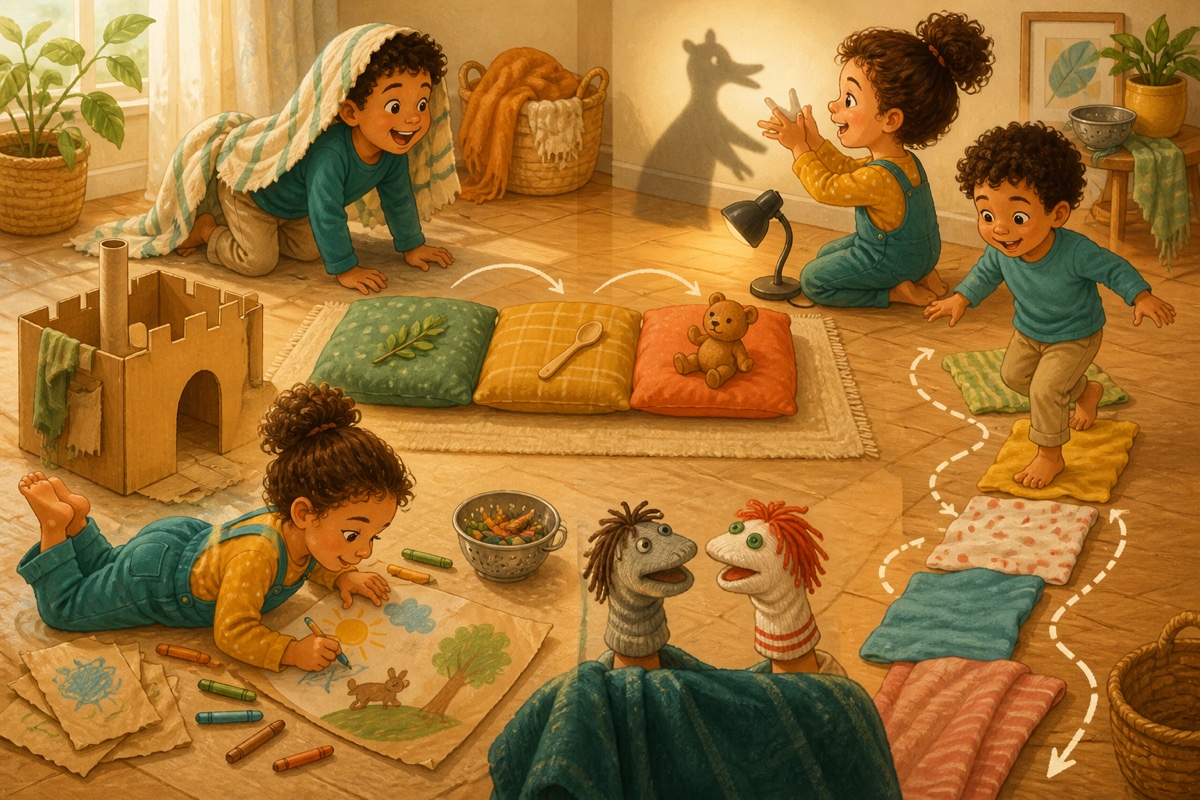
1–2: tell with movement and make three frozen scenes
First, choose three character movements—walk slowly, stop to listen, and jump across. One person performs the sequence while another remembers it or changes the rule by reversing it. Two actions are enough for a younger child. An older child can add “freeze when you hear rain” to practice holding and inhibiting a response within play.
Second, make three still scenes with bodies: beginning, problem, ending. Take turns posing or placing objects as characters, then connect the scenes aloud. If the sequence differs from the book, do not correct it immediately. Ask, “In your version, what takes us from scene two to scene three?”
- Materials: a safe patch of floor
- Time: 5–10 minutes
- Simplify: use two movements or two scenes
3–4: sequence objects and test another solution
Third, let spoons, clean lids, or three paper pieces represent events. The child orders them, then the adult swaps two and asks how the story changes. This is not a recall test. If the child invents another sequence, receive it as a new version and ask about the cause.
Fourth, take one story problem and offer no more than four safe materials: perhaps a cup, spoon, paper ball, and cloth. Ask, “How many ways could we help?” The adult manages water, sharp objects, choking hazards, and weight, but need not demonstrate an answer first.
5–6: map the story on the floor and borrow a character's voice
Fifth, use a string, towel, or tile line as a route with a beginning, problem point, and destination. The child walks and tells, then adds a fork and decides what a character would choose. In a small space, walk two fingers across a table and use three objects as places.
Sixth, say one line with different feelings—afraid, relieved, or curious—and notice how its meaning shifts. A child need not imitate the adult accurately and can use a face, body movement, or tapped rhythm instead of spoken words.
7: change one condition and build a new ending
Change one condition: the stones are too large, the rain does not stop, or another character arrives first. Let the child tell, draw, or act out the resulting ending. The adult can remember the agreed condition without controlling every detail for realism.
Harvard's EF activity guide emphasizes age-appropriate games with manageable challenge and a decreasing adult role as children can hold the rules. These activities are practice opportunities, not tests or evidence that one story raises an EF score.
- Ask what should stay available for later play
- Return objects to their places together
- Record an idea only if the child wants to remember it; do not score it
Stories ready to become play
Continue reading
Sources
- Activities Guide: Enhancing and Practicing Executive Function Skills — Center on the Developing Child at Harvard University (2014)
- Learning About Emotions Through Play — UNICEF Serbia