Read–play–work
Read–play–work: what it means and how to use it at home
“Read–play–work” is a memorable framework communicated to Thai families by psychiatrist Dr. Prasert Palitponganpim: read stories together, protect time for play, and include children in useful real work at an appropriate level. It is not an accelerated development schedule, a set of products, or three separate hour-long lessons. Hoot Tales is not affiliated with or endorsed by Dr. Prasert. We have summarized the cited source and designed our own home examples.
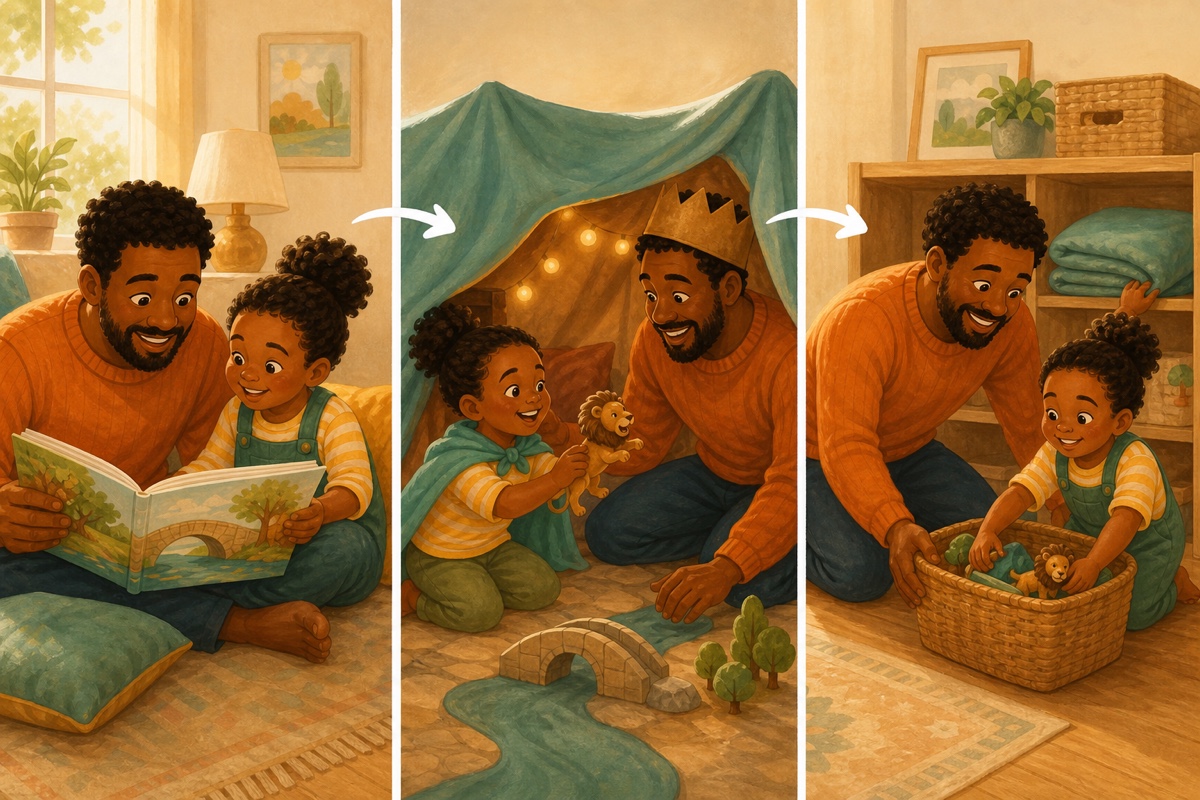
How the three parts connect
Reading gives children images and language. Play lets them transform those images into their own worlds, rules, and roles. Real work asks them to plan, act, and see that their effort affects other people. Across the three contexts, everyday opportunities arise to focus, remember a task, adjust a plan, and wait.
The connection matters more than counting minutes. A family might read about ducks in a storm, build a shelter from cushions in play, and then return the cushions together. This is not an “EF lesson” requiring a score; it is an ordinary sequence in which the child has a goal and a genuine role.
Read: create a time when the adult is truly present
Choose a fairly predictable moment and put the adult's phone out of reach. Let the child choose, follow their pace, and avoid rushing to state the moral. Listening asks children to hold characters and events briefly in mind, connect cause and effect, and imagine what cannot be seen—but no single book should be claimed to “build EF” by itself.
If ten minutes is what you have, offer those ten minutes willingly. Stop mid-story and remember together where tomorrow will begin. Continuity comes from a rhythm the family can sustain, not an ambitious target that leaves adults and children feeling unsuccessful.
Play: let the child hold the main idea
Free play does not mean the adult disappears. Adults make the space safe, limit materials to a manageable choice, and help when conflict exceeds the child's capacity, but they need not prescribe a polished result or solve every problem. Harvard's Center on the Developing Child describes age-appropriate play and games as opportunities to practice working memory, self-control, and cognitive flexibility.
Begin with ordinary things: a box, cloth, spoons, paper, and paper characters. If the child declares the box a boat, ask what the journey needs and then step back. Changing the rule midway can be practice in flexible thinking, not incorrect play.
Work: offer a real task and enough time
A child's work should matter to the household: placing spoons, wiping a spill, matching socks, watering a plant, or putting play materials away. Break it into manageable steps, demonstrate once, then reduce instructions. Do not manufacture a mess merely for practice or use a task beyond the child's capacity as punishment.
Describe observable effort rather than labeling identity: “You remembered to put away the spoons before wiping the table,” rather than “You're the best.” If something spills or takes time, help reorganize the steps. Error and repair are natural parts of real work.
- Younger child: put one item away or place cloth in a basket
- Preschooler: set a simple table, water a plant, wipe a small area
- Early primary: pack from a checklist, fold simple laundry, help with a safe cooking step
A sample day without crowding the schedule
Read for ten minutes before bed. The next day, let a story role appear in free play if the child wants it, and include one useful household task in the evening. The three need not connect to a book every day, and no score sheet is required. Notice only what the child initiates, when help is requested, and which routine is too demanding.
Executive function is an umbrella for several capacities, not a diagnosis or a ranking of children. If a child has persistent difficulty managing everyday tasks, discuss the real context with a teacher or an appropriate professional. This article is general education and does not claim a named individual's specialist review.
Read, then extend
Continue reading
Sources
- คู่มือการจัดกิจกรรมสนามเด็กเล่นเพื่อเสริมสร้างทักษะสมอง EF สำหรับครู พ่อแม่ และผู้เลี้ยงดูเด็กปฐมวัย — มูลนิธิศุภนิมิตแห่งประเทศไทย (2024)
- Activities Guide: Enhancing and Practicing Executive Function Skills — Center on the Developing Child at Harvard University (2014)
- InBrief: Executive Function — Center on the Developing Child at Harvard University