Original Stories
How Many Times Did Jeed Call?
⏱ 3–5 min
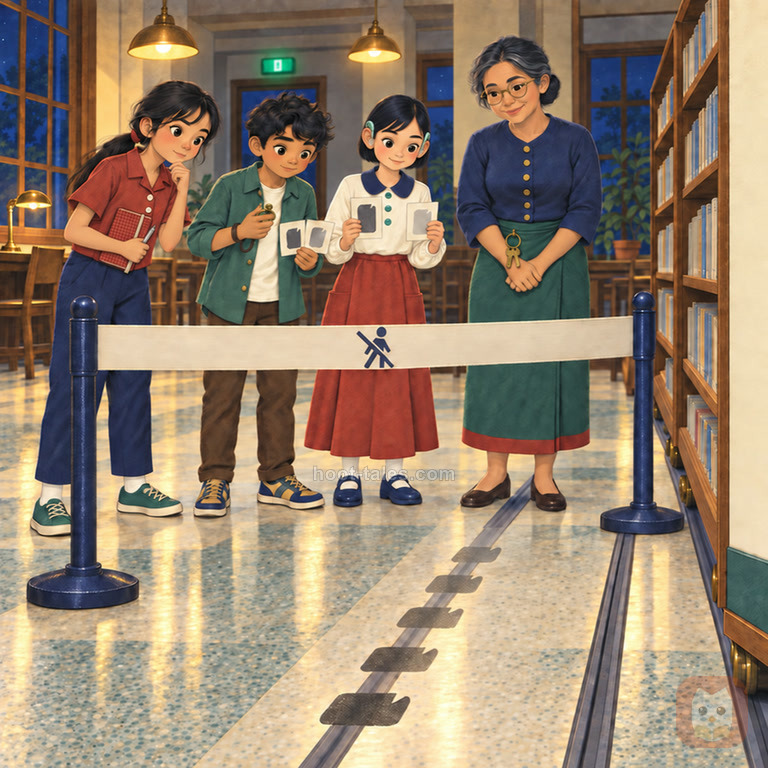
After securing the first map fragment, Aunt Praw led Waat, Yusuf, and Tonliu to the old periodicals room by following a line on their copied plan. A staff barrier stood on the dry path outside. Beyond it, six wet marks ran along the center of a floor rail and stopped at a cream panel that looked like a solid wall. “No one crosses the barrier,” Aunt Praw reminded them. “We observe from this side first.”
Aunt Praw photographed each mark and displayed the pictures on a large screen. Tonliu arranged six picture cards in the center of their circle and asked everyone to speak one at a time. Every mark was the same rounded rectangle, facing the same way, with a V-shaped nick in the same corner. “If these are shoeprints,” Waat thought aloud, “where is the left-and-right pair?” Yusuf wrote down two hypotheses: a walking person or drips from the ceiling.
On the photographs, Waat measured from the center of one mark to the next with paper strips. All five gaps were exactly equal, although each watery edge grew fainter. Tonliu traced the thin rail running through the middle of all six marks. “The ceiling above the rail is dry, and drips would not repeat the same nick every time,” she said. Yusuf moved the drip card into the unsupported pile, but he did not discard the shoe idea yet.
A copy of the building plan made everyone pause. The true wall line ended before the cream panel, and three rails continued beneath it. Looking from the side without crossing the barrier, they saw a narrow gap and the edge of shelving. “This is the end panel of a mobile shelf, not a wall,” Waat said. Aunt Praw brought them a retired rubber-covered wheel from the same old system. Its tread carried a V-shaped nick like the one in every photograph.
At the low table, Aunt Praw touched the sample wheel to a sponge dampened with clean water. Under her supervision, Yusuf rolled it along a sheet of fresh paper. Each full turn brought back the same rounded mark and V-shaped nick. Waat set the measuring strip beside the paper—the gap matched all five intervals on the floor. Tonliu ordered picture cards for “touch—turn—touch again.” The new marks faded just like the old ones. The shoe hypothesis had failed the test.
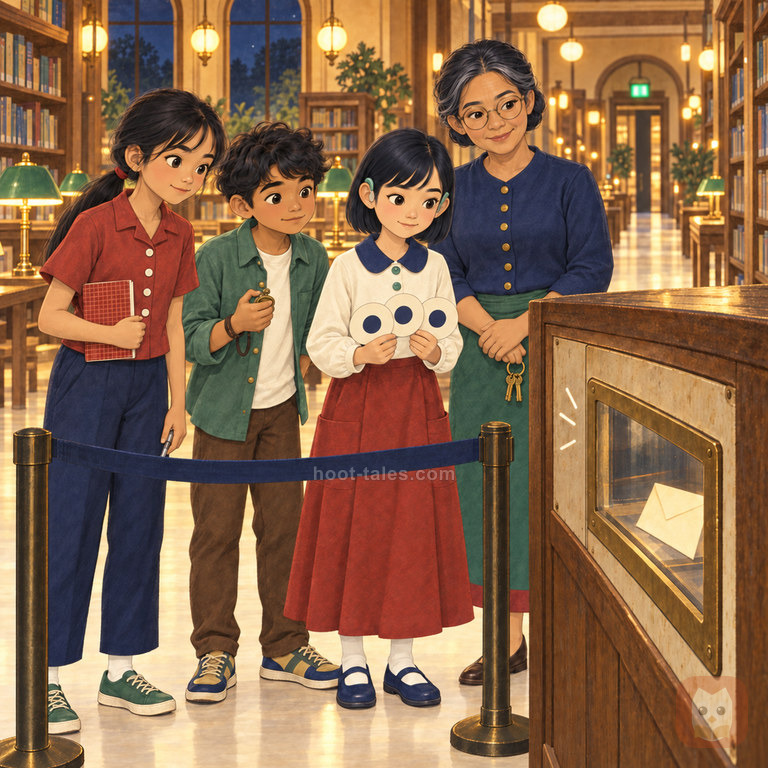
The children explained their answer. The six marks had not walked; the same point on one wheel had returned to the floor after every turn. The rail carried the marks beneath the shelving's end panel, making them seem to vanish through a wall. Aunt Praw called the building staff, confirmed that the aisle was empty and the safety indicators were ready, and kept the children behind a stop line. She operated the shelving herself. The “wall” moved slowly aside, revealing an ordinary aisle and an envelope on a fixed stand behind it.
The envelope held the second map fragment: the upper-right corner. Aunt Praw placed it in a clear sleeve beside the upper-left piece. Waat joined the lines on her copy, Yusuf recorded the wheel's one-turn distance, and Tonliu added a picture card for “look—measure—test.” When the floor was dry, staff removed the barrier and the shelves rested quietly in place. What had looked like marks walking through a wall now told the complete story of one turning wheel.
A familiar shape may invite a guess, but measuring, testing, and looking from another angle can separate what something resembles from what really happened.
Six wet marks lead straight to a solid-looking wall in the old periodicals room. Waat, Yusuf, and Tonliu must compare shapes, measure a repeating interval, and test a sample wheel to explain why the marks were never footsteps at all.
More stories from the same collection, picked for you
Original Stories
⏱ 3–5 min

Original Stories
⏱ 3–5 min

Original Stories
⏱ 8–13 min

Original Stories
⏱ 8–12 min
Original Stories
⏱ 9–13 min