Original Stories
Bangkok Canal Detectives: The Code in the Old Market Ledger
⏱ 6–9 min
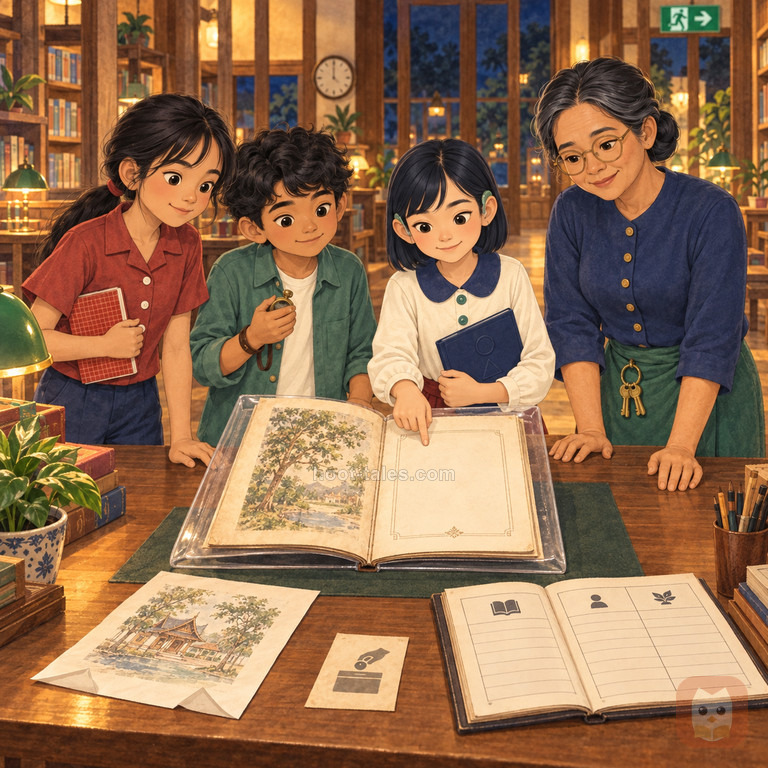
At the warm reading table, Aunt Praw placed a display copy of a handmade community book inside a clear sleeve. Its last page had an empty credit space. Waat spotted an issue 12 mark on the copied cover. “Who made it?” Yusuf asked. Aunt Praw said the founders had left this question with copied records to examine; the original stayed in the staff area. Tonliu arranged three picture cards—book, makers, and donor—so the team would not mistake one role for another.
Yusuf pointed to the round handwriting on the last page. “Could we match it to the donor’s card?” Waat almost wrote down a name, but Tonliu shook her head. “One person might have copied another’s words, and several people can make one book,” she said, facing her friends as she spoke. Aunt Praw agreed. The team wrote down two possibilities: the writer was the donor, or several people had worked together. They set the name guess aside.
Aunt Praw brought over a copy of the last page and a copied donation slip. Waat noticed an issue 12 mark and two small folds at the two upper corners of the page. A drawing on the slip showed the same double fold. “This may be the copy from that donation,” she said. Yusuf recorded both clues without touching the original book. Tonliu placed two picture cards side by side for everyone to check. But the slip named who had brought the book, not who wrote, drew, or stitched it.
The copied register had two similar entries: issue 12 and issue 21. Waat tried matching by number alone. Yusuf noticed that the drawing for issue 21 had one fold, while issue 12 had two. Tonliu laid out picture cards for one fold and two. “If we mix up the numbers, the folds give us another check,” she said. They ruled out issue 21 and the handwriting guess. Aunt Praw checked the match again on the copies.
Once they matched issue 12, the register showed three maker roles: storyteller, illustrator, and book stitcher. A separate space listed the donor. “Donating it doesn’t mean making all of it,” Waat said. Yusuf explained their checks to Aunt Praw: the issue number, the double fold, and the roles in the matching register entry. Tonliu turned her picture cards so everyone could follow the same order. Aunt Praw agreed, then reminded them that knowing the makers’ names did not mean they could put those names on a sign without asking.
Aunt Praw checked the donation terms in the staff file, then spoke separately with the makers who were attending the event. The children stayed in the reading court with other adults and did not see private contact details. Two makers agreed to first names on a temporary sign. The stitcher smiled and asked to be credited only as “book stitcher.” Tonliu asked, in front of the team, “Can we write what each person chose?” Aunt Praw said yes and read the choices back for everyone to check.
On the temporary sign, the team wrote the agreed credits: Mali for the story, Arun for the pictures, and an unnamed book stitcher. Aunt Praw checked the sign before placing it beside the display copy. From the puzzle envelope, she gave Waat the fifth plan piece, a central strip that joined the four corners. The lines met, but a space for readers’ needs was still blank. “The plan tells us where the room is,” Yusuf said. “To learn whom it should serve, we need to ask the people who will use it.” They put the copies away and settled down to read together.
Evidence can show where a work came from. Good credits also ask its makers how they want to be named.
A display copy of a handmade community book has no maker credits. Waat, Yusuf, and Tonliu compare its issue number, folds, and donation register before asking how each maker wants to be credited.
More stories from the same collection, picked for you
Original Stories
⏱ 6–9 min
Original Stories
⏱ 6–9 min
Original Stories
⏱ 3–5 min
Original Stories
⏱ 3–5 min
Original Stories
⏱ 8–13 min