Original Stories
The Library After Twelve Bells: Room Zero
⏱ 8–13 min
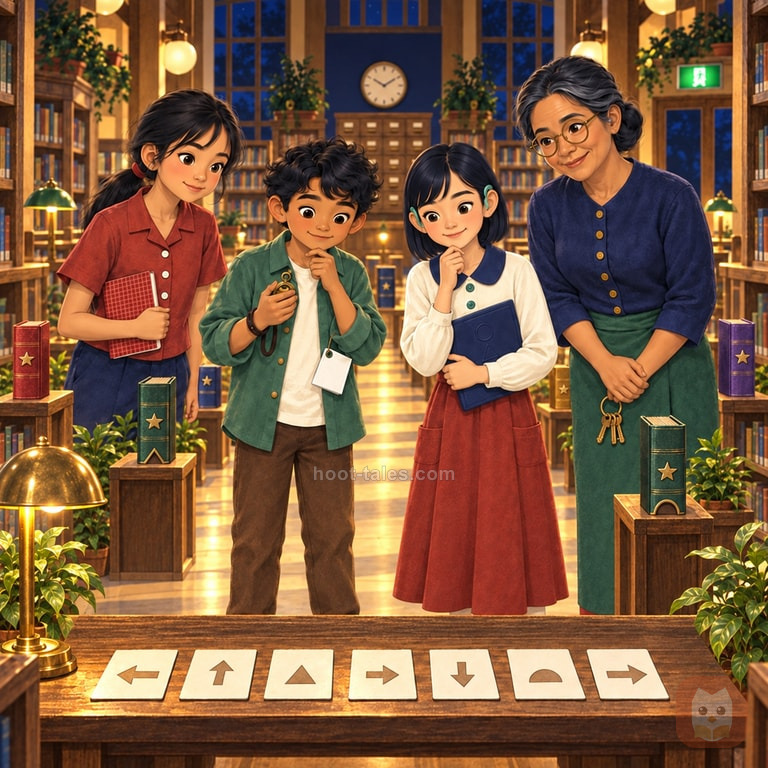
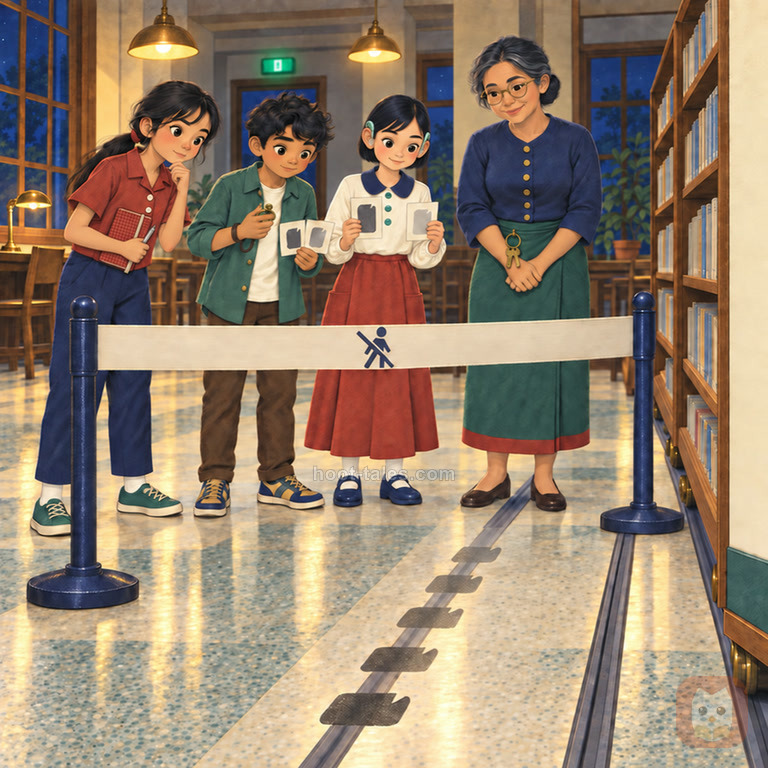
After finding the cause of the knocks, Waat, Yusuf, and Tonliu followed Aunt Praw to a display in the reading court. Seven replica books in different sections each carried one raised star on its spine. Seven copied guide cards lay on a low table. Aunt Praw showed them the wide public aisle. “Look from here, and test your ideas with the copies only,” she said. The colored stars seemed to make a path, but no one knew where it began.
Yusuf tried arranging the star cards from lightest to darkest. But jade appeared twice, and the route Waat drew in her notebook looped back to the same shelf. “If we use color alone, two people might choose different books,” Tonliu said. She pointed out the star frames: some had triangular notches, while others had semicircular ones. Aunt Praw stayed beside the table and asked them to keep the color idea for another check.
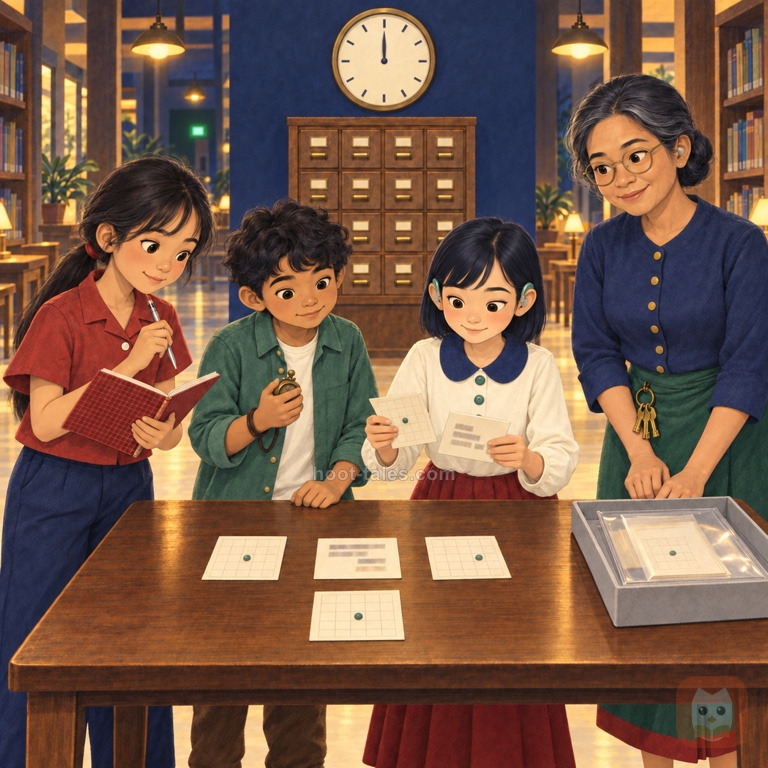
Waat read the section numbers beneath the seven stars: 000, 100, 300, 400, 500, 700, and 900. “Numbers may give us an order, but which card belongs to which book?” she asked. Yusuf suggested starting with the brightest color. Tonliu suggested checking each number and notch together. Every card had a section number and notch, but the cards were still mixed on the table. Aunt Praw confirmed that every section was on the same public route.
The children compared the copied cards with a diagram of the star frames that Aunt Praw provided. They left the books on the shelves. The two jade stars had different notches: the card numbered 300 matched a triangular notch, while 500 matched a semicircular notch. “The same color does not mean the same stop,” Yusuf said, crossing out the color route. Waat redrew the line in her notebook, and Tonliu laid out the pairs so everyone could check them.
Once they had matched all seven numbers and notches, Tonliu turned the cards over. Words in Thai and English gave each card a role: “เริ่ม/start” on 000, “ต่อไป/next” along the way, and “จบ/finish” on 900. Raised arrows on the card edges pointed along the wide aisle. Waat ordered the numbers from smallest to largest. Yusuf checked every notch against its spine. “It is a reading route, not a color sequence,” he said. Aunt Praw checked that the aisle was clear.
Aunt Praw walked with all three children. They checked the stars in order—000→100→300→400→500→700→900—and matched the notch at every stop. Waat mapped the route, Yusuf checked the numbers, and Tonliu pointed out the arrows for the team. No one had to guess from color. At 900, the finish card pointed to a low display stand beside the shelf, not behind it. A cream envelope rested on the stand, within Aunt Praw's reach on the public side.
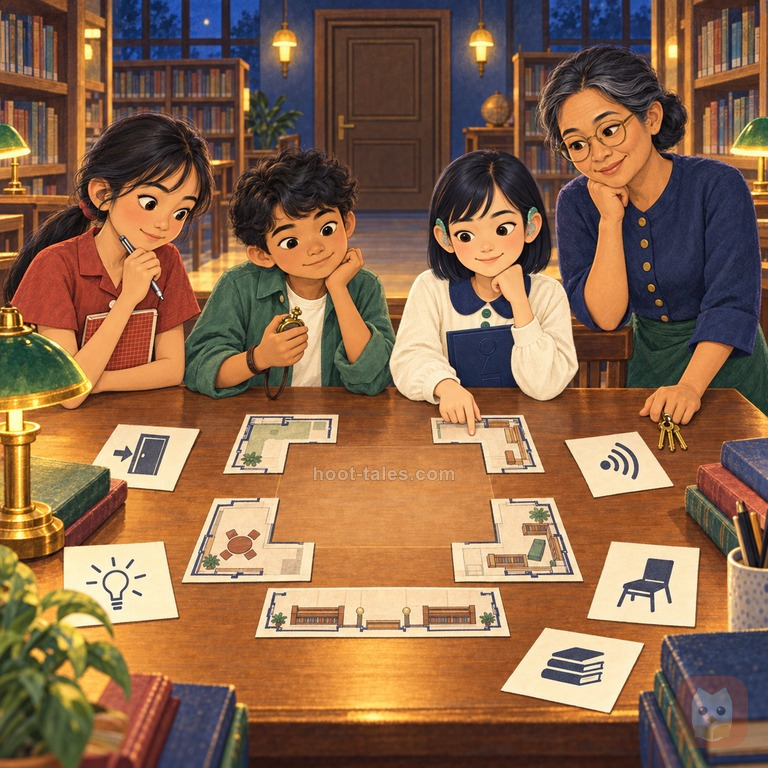
Aunt Praw opened the envelope on a support tray. Inside was the fourth plan fragment: the lower-right corner. Waat placed it beside the three earlier corners, leaving the middle strip open. Yusuf recorded how the color route had doubled back; Tonliu kept the number-and-notch cards together. “If real signs can be read in several ways, more people can find books,” she said. Aunt Praw invited everyone to choose a book to read in the warm, quiet court.
When color is not enough to guide us, numbers, shapes, and words let everyone check the same route.
Seven raised stars mark book spines across the library, but their colors lead Waat's team astray. Call numbers, notches, and bilingual route cards help them find a path they can all check.
More stories from the same collection, picked for you
Original Stories
⏱ 8–13 min
Original Stories
⏱ 8–13 min
Original Stories
⏱ 9–13 min
Original Stories
⏱ 8–12 min
Original Stories
⏱ 7–11 min